Small but mighty USB-C powered 802.3at PoE+ power injector for everyday use

Some of you have asked about the tiny USB-C to PoE+ power injector I carry around in my everyday backpack. I have tested more than half dozen of injectors. PoE Texas GAT-50V30W-V2 is compact, lightweight, and it is always there whenever and wherever you need to power an access point on the go. It can be powered by a USB-C battery pack or an AC charger with USB-C output.

Catalyst 9105 AP powered by small battery pack using PoE+ injector
Small but mighty

Use cases

I use this setup to convert Wi-Fi 6E and Wi-Fi 7 access points between cloud-managed and controller-managed modes.

Also, it allows me to power an AP while travelling and connect it to a Catalyst 9800 controller running on my MacBook. How? Stay tuned for another blog post.

Demonstrations at events, AP staging with no switch or network infrastructure available, and site surveying, are other things I do.

All you need is

  • PoE Texas GAT-50V30W-V2 power injector
  • USB-C battery pack which supports 12V on its output USB-C port. I am using Anker 533 PowerCore 30W here.
  • Short 20-30 cm USB-C Power Delivery trigger cable which requests 12V from the battery pack and adapts it to DC barrel jack
  • Short patch cable
  • The apple is optional 😉
All you need to PoE power any 802.3at capable AP. Anywhere.

Powered by a battery pack or AC power

The beauty of this solution is that all you need to power the injector is 12V USB-C power source which can be a small USB-C battery pack.

PoE Texas injector powered by USB-C battery pack

Or you can just use your USB-C charger (again it needs to support 12V DC on its output) and power it that way. No AC power cables needed in your back.

PoE Texas injector powered by USB-C charger

Tested access points

I use it with Cisco access points C9105, CW9172H, CW9172I, CW9174I, CW9176I, CW9179F. No surprises, it just works.

Does it support multigigabit Ethernet?

Officially, it doesn’t. But with a short patch Ethernet cable, which is 99% of my use cases, it does.

Connected to a C9200CX compact switch using a 2-metre CAT6 patch cable, CW9174I access point happily auto-negotiates 5 Gbps full duplex and works just fine.

Battery life

Powered by Anker 533, I get about 1-2 hours of battery life. It depends on how much the AP draws. Obviously, the higher the capacity of your battery pack the longer it lasts. For everyday occasional use, I prefer a compact battery pack that gives me 1 hour of uptime over a heavy battery.

Looking for USB-C battery powered 802.3bt/UPOE/PoE++ injector?

If you are looking for the most powerful USB-C powered injector which supports UPOE/802.3bt/PoE++, check my other blog post here. It is larger though.

CW9179F powered by 802.3bt power injector

Regulatory note: Keep in mind that Low Power Indoor (LPI) access points shall not be battery powered. Refer to EN 303 687 and FCC KDB 987594.

Incompatible power injector with Cisco Catalyst Wireless CW9166 Wi-Fi access point

Just a very quick reminder that if you power your CW AP using an incompatible 802.3at power injector, you will likely see the AP successfully boot up, but it disables its radios few seconds later. The result is no SSID put on the air.

What to look for in the logs?

If you console or SSH into the AP, you will see this error message. Followed by radio interfaces going down.

set_sys_cond_state: condition critical state 4
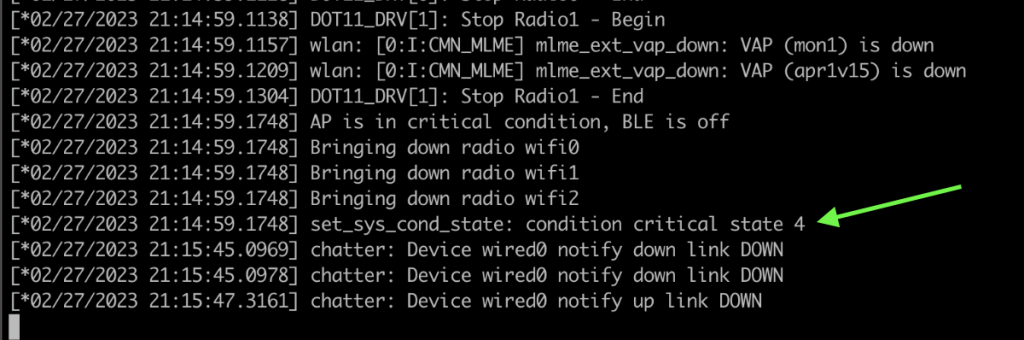
condition critical state 4 error message

That’s it. Use officially supported injectors, and save yourself from the trouble I ran into 😊